
Learn more about...

One Question, A Lifetime of Discovery
September 21, 2026
By Kiersten Caputy
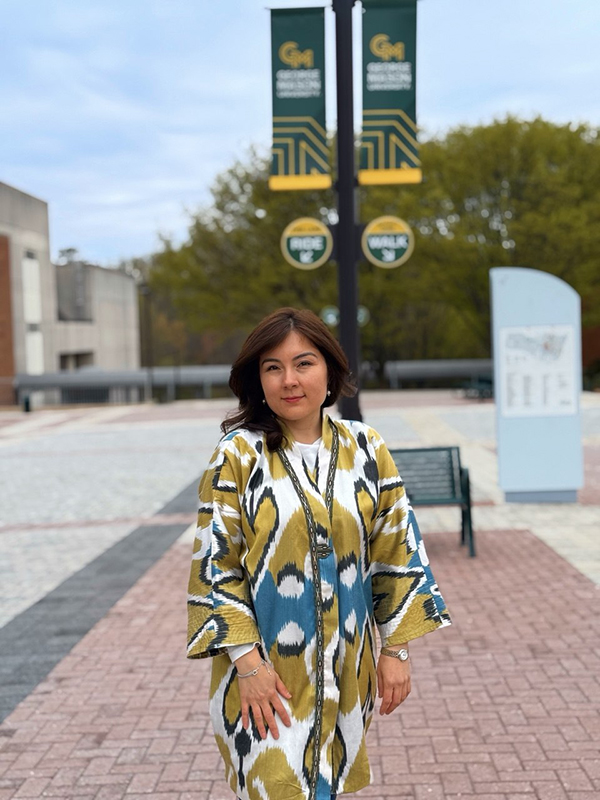 Dildora Khakimova
Photo Provided
Some researchers begin with a field. For College of Education and Human Development (CEHD) alumna Dildora B. Khakimova, PhD ’25, the journey began with a question, and the question began on a wall. The hallways of her bilingual School No. 249 in Tashkent, Uzbekistan, were lined with quotations in Uzbek and Russian. One stayed with her: “Kimki hayotdan olmasa ta’lim, unga o‘rgata olmas hech bir muallim.”
Roughly translated: “No teacher can teach a person who does not learn from life.”
Khakimova was eight or nine years old when the quotation prompted a question that would stay with her: What is learning, and how do people learn?
At the time, she could easily read, understand, and remember the words written in her native Uzbek. She could read many of the Russian words too, but reading them did not necessarily mean understanding them. “I cannot recall a single Russian quotation from those school walls,” she said. The distinction between recognizing words and constructing meaning stayed with her, eventually becoming one thread connecting two doctoral journeys: first in developmental psychology and akmeology in Uzbekistan, and later in teaching, teacher education, and international education at George Mason University.
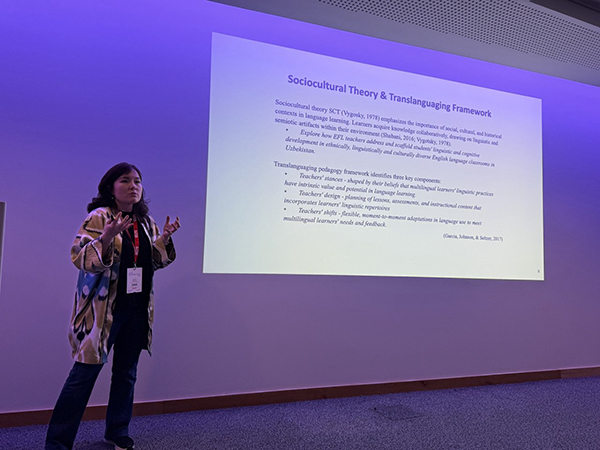 Dildora Khakimova
Photo Provided
Today, Khakimova is an associate professor of Research Methodology at the University of World Economy and Diplomacy (UWED) and an instructor in the MA TESOL program at the American University of Technology. Her work brings together developmental psychology, multilingual and teacher education, mixed-methods research, and a growing focus on how artificial intelligence is reshaping teaching, learning, and research.
At UWED, Khakimova puts this interdisciplinary approach into practice through research methodology teaching and academic capacity-building across undergraduate, master’s, and doctoral programs. She also established the Academic Reading and Writing Club, creating a space for multilingual and multicultural students to develop research ideas beyond the classroom and move toward independent research and conference participation. Her teaching increasingly incorporates critical and responsible engagement with artificial intelligence, connecting methodological training with broader questions about how emerging technologies shape research and learning.
That pursuit has led to collaborations with organizations including UNAIDS, UNFPA, and WHO. Since 2012, Khakimova has coordinated more than ten international research, professional development, and capacity-building initiatives, including workshops for national and international specialists' adaptation of WHO guidance to the context of Uzbekistan, and development of bilingual online learning content. Her current work includes coordinating the conceptual and methodological development and implementation of an online course on HIV and gender for key stakeholders as a UNAIDS consultant. Across these projects, her work has centered on translating global evidence into approaches that are methodologically sound, contextually appropriate, and usable within local systems.
"The technical review was only one part of the work," she explained. "We compared international evidence with national law and clinical practice, translated terminology that did not always have an equivalent, argued about sensitive topics, and decided together what could be approved, what needed revision, and what could not be accepted at all." For Khakimova, the experience reinforced one of the most important lessons of her career. "People from different linguistic, professional, and institutional backgrounds can use the same term while understanding it differently," she said. “A researcher may focus on methodological rigor, a practitioner on what can realistically be implemented, a government representative on existing regulations, and a community member on how a decision will affect people’s everyday lives. Each perspective is valuable, but none is complete on its own.”
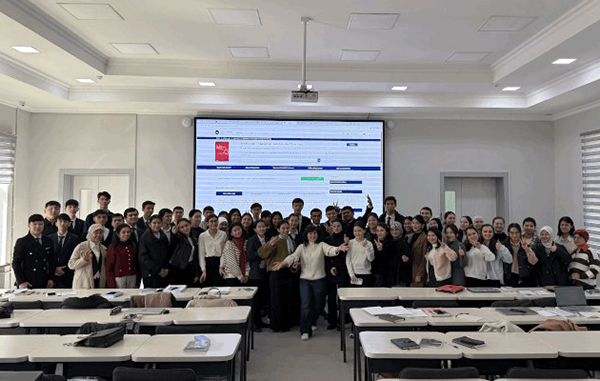 Dildora Khakimova
Dildora Khakimova
That philosophy was strengthened during Khakimova’s doctoral studies at George Mason University. Although she entered CEHD already holding a doctorate in developmental psychology, she credits George Mason faculty with deepening both her research and her understanding of leadership.
Beverly Shaklee helped her develop a stronger awareness of researcher positionality and scholarly identity, while April Mattix Foster shaped her thinking about intercultural competence. Divya Varier’s courses in measurement, mixed methods, and program evaluation were particularly influential in her methodological development, strengthening her ability to ask not only whether a study was rigorous, but whether its methods and instruments actually captured what they claimed to measure across linguistic, cultural, and educational contexts.
Under the mentorship of Joan Kang Shin, Khakimova had opportunities to apply and extend that learning through international education projects including English-Speaking Nation (ESN), TSSET, and Teaching English to Young Learners (TEYL). She continued to deepen that work alongside Rebecca Fox, Anya Evmenova, and the GOTEC team through international research, proposals, and scholarly projects. These experiences also sharpened her awareness that shared terminology does not necessarily mean shared understanding. Across languages, professions, and institutions, the same concept can carry different assumptions and meanings. “Moving between Uzbek, Russian, and English is not simply a matter of translating words,” she said. “Languages carry histories, relationships, and culturally specific ways of meaning something.”
At George Mason, Khakimova also found a name for something she had experienced since childhood. “Through Dr. Sujin Kim’s course, I came to understand my own multilingual and multicultural experience through the concept of translanguaging, and realized that I had been drawing on all the linguistic resources available to me to construct meaning across languages since my elementary school years.” she explained. The concept connected an experience that had begun in a bilingual school hallway with the questions she would later investigate as a researcher: how multilingual learners draw on their linguistic resources to understand, communicate, and learn.
Her dissertation, supported by a 2024 TIRF Doctoral Dissertation Grant, brought many of those experiences together in a mixed-methods study of 297 teachers of English across Uzbekistan.
 Dildora Khakimova
Photo Provided
What Khakimova carried from CEHD extended beyond methodology. “The most important lesson I carried forward is that leadership is not about having all the answers,” she said. “It is about creating the conditions in which people can ask better questions, contribute meaningfully, and learn from one another.”
Looking across these experiences, Khakimova sees knowledge moving in both directions. Her work with international organizations taught her how global evidence must be adapted to local contexts. CEHD showed her how evidence from local classrooms can, in turn, contribute to international research and practice. “The strongest partnerships are those where no country is only a source of knowledge, and no country is only its recipient,” she said.
Today, Khakimova’s research increasingly focuses on artificial intelligence and multilingual learning. “I started by asking how people from different cultural, linguistic, and educational backgrounds make meaning and learn,” she said. “That question still guides my work with multilingual learners and teachers, and now it also shapes how I study what happens when artificial intelligence becomes part of learning, communication, and the ways people access, interpret, and use knowledge.”
Artificial intelligence has given that question a new form. “I do not only use AI,” she said. “I study it.” Her current research examines how generative AI and AI-assisted research tools engage with multilingual and culturally situated data, with particular attention to what may be preserved, transformed, or lost when complex human meaning is mediated through artificial intelligence.
This work has brought her back to a distinction that has followed her since childhood: fluent output is not necessarily evidence of understanding. “The simplest way I can express the challenge is this: AI may recognize what people say without fully capturing what they mean by saying it in a particular language and context,” she said. “As a child, I could read the Russian quotations on my school walls without understanding their meaning. Decades later, I find myself asking a related question about technologies that can produce remarkably fluent language: what does it actually mean to understand?”
For Khakimova, the issue extends beyond whether AI will replace particular tasks. As these systems increasingly mediate access to explanations, feedback, translation, and information, they may also influence how learners formulate questions, evaluate knowledge, and decide what constitutes a strong answer. “My concern is not simply that AI might replace certain tasks performed by educators,” she said. “It is that systems that do not adequately represent diverse languages and cultural contexts may begin to define what counts as a strong or appropriate answer for everyone.
As she reflects upon her time at George Mason, Khakimova sees graduation not as the end of a chapter, but the continuation of a global community of scholars committed to asking better questions and creating meaningful change. “Being a CEHD alumna means both belonging and continuation,” she said. “I remain part of the community that helped shape me, but I also have a responsibility to extend that community outward: to create connections, share opportunities, and help make voices and experiences from Uzbekistan and Central Asia more present in the conversations where knowledge is being produced.”
For Khakimova, the question that first emerged in a school hallway decades ago continues to guide her work today. As her research reaches classrooms, institutions, and international partnerships around the world, it is helping countless others ask that same question with greater curiosity, deeper understanding, and a renewed commitment to learning.
This story supports the Future Ready Teachers initiative and our priority of reclaiming the narrative around teaching as a profession.