
Learn more about...

When Learning Begins With the Problem
January 26, 2026
By Christy Hudson
At ACCESS Academy, learning begins not with an answer, but with a problem.
That choice reflects the program’s mission: to expand access to advanced academic experiences by identifying and nurturing talent wherever it exists. Rather than defining readiness by prior opportunity or test performance alone, ACCESS Academy is built on the belief that students develop advanced abilities through meaningful intellectual challenges. Problem-based learning (PBL) provides the structure for that belief to become a practice.
“Problem-based learning reflects ACCESS Academy’s commitment to preparing students for real-world complexity, where learning is active, connected, and grounded in purpose,” said Ingrid Guerra-Lopez, Dean of the College of Education and Human Development, who led the vision and design of ACCESS Academy.
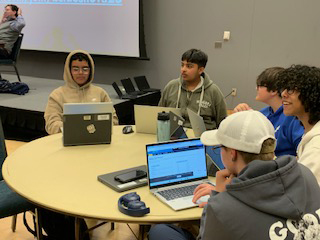
“Problem-based learning allows us to see students’ thinking in real time,” said Kimberley Daly, a problem-based learning expert leading the integration of PBL across student and teacher development at ACCESS Academy. “When students are working through complex, authentic problems, they show us how they reason, how they collaborate, and how they persist. That’s how we identify and develop potential that might otherwise go unnoticed.”
From the moment students encounter an ill-structured problem, they are positioned as thinkers, decision makers, and stakeholders. The problems they engage with are intentionally complex and unresolved, mirroring the kinds of challenges professionals and communities face beyond school. Information is revealed gradually; perspectives often conflict, and no single pathway leads to a guaranteed solution. Students must determine what they need to learn, where their understanding is incomplete, and how new knowledge might reshape their thinking. In this way, learning is not something delivered to students, but something they actively construct in collaboration with instructors.
This approach is often confused with project-based learning, but the distinction matters. In many classrooms, projects serve as a culminating activity, with students applying content after instruction has already occurred. At ACCESS Academy, the problem itself initiates learning. Students encounter uncertainty first, before formal teaching, and that uncertainty drives inquiry. The goal is not simply to produce a polished final product, but to develop habits of mind associated with advanced learning, including reasoning with evidence, tolerating ambiguity, collaborating with others, and revising ideas in response to new information and changing conditions.
As students work through a problem, classrooms become spaces for collective sensemaking. Early discussions surface what students know and, just as importantly, what they do not yet know. Questions shape the direction of learning. Students research, analyze informational texts, engage in sustained dialogue, and test emerging ideas. This process supports ACCESS Academy’s vision of academic rigor grounded in equity, ensuring that students from diverse backgrounds have opportunities to demonstrate high-level thinking through multiple pathways, not just speed or recall.
Teachers play a critical role in making this work possible. At ACCESS Academy, educators are supported in shifting from the role of content deliverer to that of facilitator and learning designer. This shift requires intentional professional learning and a willingness to embrace productive discomfort. Teachers carefully balance scaffolding with autonomy, intervening to support student thinking without removing the cognitive demand that makes problem-based learning powerful. Over time, many describe a transformation in how they see both their students and their own professional identity.
Assessment in this model is aligned with the Academy’s commitment to growth and development. Rather than relying solely on traditional tests or end-of-unit products, teachers attend to the learning process itself. They look for evidence of reasoning, collaboration, metacognition, and knowledge application. As Daly explained, “We’re not just asking what students know at the end of a unit. We’re paying attention to how they get there and skills students are developing along the way. That process tells us far more about readiness, growth, and potential.”
The impact of this work extends beyond individual classrooms. Research shows that students engaged in problem-based learning develop stronger problem-solving skills, deeper conceptual understanding, and greater motivation to learn. They are more likely to retain knowledge over time and to transfer it to new and unfamiliar contexts. Just as importantly, they gain confidence in navigating complex tasks, an essential skill for advanced coursework and future academic and STEM pathways. According to Daly, this is precisely the point. “The world our students are entering doesn’t come with clear instructions,” she said. “By engaging with complex problems now, students learn how to think through uncertainty, listen to multiple perspectives, and make informed decisions. Those are skills they’ll carry with them long after they leave ACCESS Academy.”
For ACCESS Academy, problem-based learning is both an instructional model and a statement of purpose. It reflects a belief that talent is developed through opportunity, that rigor and equity are not competing goals, and that students rise to high expectations when they are trusted with meaningful intellectual work. By centering learning on authentic problems and supporting teachers as designers of inquiry-rich experiences, ACCESS Academy creates an environment where students do more than learn content. They learn how to learn.
In classrooms shaped by this vision, students are not preparing for challenges later. They are already engaging in them. Learning begins with questions, unfolds through collaboration and reflection, and culminates not in a single right answer, but in deeper understanding. Through problem-based learning, ACCESS Academy lives its mission every day, expanding access, cultivating potential, and preparing students to think boldly about the world they will help shape.