
Learn more about...

Counseling Program Faculty is Presented with the “Counseling Vision and Innovation Award” by the Association for Counselor Education and Supervision (ACES)
December 1, 2025
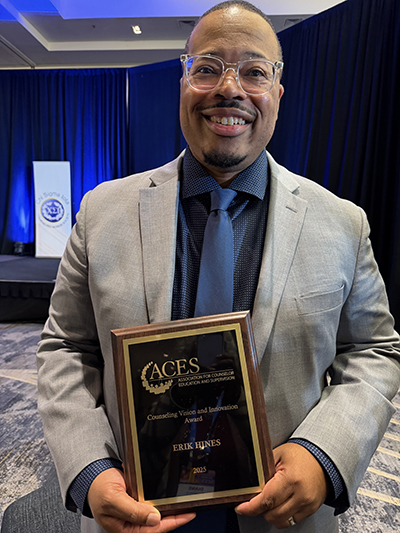
Erik Hines
Photo Provided
Erik Hines, Professor in the Counseling Program at George Mason University, was named the recipient of the “Counseling Vision and Innovation Award” by the Association for Counselor Education and Supervision (ACES), an organization dedicated to quality education and supervision of counselors in all work settings. This award recognizes individuals who have demonstrated exemplary commitment, vision, creativity, innovation, and transformational leadership in advancing the profession of counselor education and in pioneering research that highlights the vital role counselors play in supporting all aspects of development in youth. Hines was presented with the award during the ACES National Conference, held October 8-12, 2025, in Philadelphia, Pennsylvania.
Upon learning that he had been selected for the award, Hines expressed his deep appreciation stating, “I am thankful to receive this award because my goal is to increase the visibility of the school counselor’s role as well as counselor education. Both disciplines can dramatically change the trajectory of the lives of individuals when data-driven and evidence-based practices, supported by research, are used to help youth and adults achieve successful outcomes in career development, educational achievement/attainment, and mental health and wellness.”
Conferral of the ACES award is a recognition of the visionary and forward-thinking approach that Hines has adopted in conducting his research and in developing practices fundamental to the counseling profession and other professional activities with which he has been involved. “This award,” he stated, “is an opportunity to continue to do innovative work through research, policy, and practice to improve the educational and holistic outcomes of students, especially Black men and boys.”
Hines elaborated on some of his career accomplishments for which he was honored with the ACES award. In each of these endeavors, Hines drew from his extensive expertise and experience in the counseling profession and in counselor education. One initiative led by Hines centered on the successful creation of a living and learning community for Black men at one of his former institutions. The objectives and components of this project were shaped by the evidence derived from the research and scholarship produced by Hines during his career. He explained, “I used innovative practices to incorporate counseling in a residential learning community as an intervention to help improve the graduation and retention rates of Black men.”
On the policy front, Hines served as the co-advocacy chair for the Florida School Counseling Association where he co-wrote legislative language to define the role of school counselors in that state. The language was introduced as HB 941/SB 1404 in the Florida House and Senate. The measure was adopted by the House but did not pass in the Senate. While the measure was not enacted into law, the ability of Hines to achieve passage of the bill in the house and to secure significant sponsorship of the measure from both chambers is a testament to his dedication and success in raising public awareness regarding the invaluable role that school counselors play in helping young people in schools.
In addition to his efforts at the state level, Hines has participated in federal initiatives to advance improvements in public education. Among these, he was invited to share his expertise and contribute to the development of a practice guide on college access and readiness that was slated for publication by the “What Works Clearinghouse” within the Institute for Education Sciences at the U.S. Department of Education.
Hines has also been the recipient of funding from the National Science Foundation in support of his research demonstrating the importance of school counselors in increasing the participation of Black male students in the STEM field. He explained that school counselors play a critical role in guiding Black men as they navigate their educational journey whether they choose to pursue a graduate degree in engineering, a career in the engineering professorate, or become a STEM teacher in P-12 schools. “I connected my research and funding related to STEM with implications for school counselors facilitating career development with Black men and boys,” Hines stated.
In his other comments, Hines elaborated on what motivated him to focus his research on the experiences of Black men and boys in the education system from preschool through graduate and professional school and beyond into their professional careers. He stated, “My research critically examines how high impact programming shapes the educational and career outcomes and experiences of Black men and boys. Getting involved in this work was a personal experience for me as I had good school counselors in junior and senior high school and not so good ones. I have always been interested in helping individuals be the best version of themselves. Thus, I sought the school counseling profession to give me the specialized skills needed to help students succeed in academics, college, and career readiness, and to develop their socio-emotional learning. Also, Black boys and men tend to have lower levels of academic and employment outcomes, and I wanted to be in a position through research, policy, and practice to improve these areas for this population.”
Hines took a moment to reflect on what he sees as a major challenge in the counselor education profession that is having an impact on the preparation of the next generation of counselors—namely, how to broach race and gender in the current political climate. Hines stated, “In our program, we have students asking, ‘How do we discuss and implement equity, social justice or culturally responsive and inclusive counseling if it is not allowed?’ Further, some counselor educators may have to seek permission to discuss this issue or have their syllabi reviewed to ensure that they are not promoting a perceived ideology or thought(s).”
Looking ahead to future opportunities in the counselor education discipline, Hines shared his thoughts on how artificial intelligence (AI), if used effectively and ethically, can help counselors and counselor educators perform their roles with efficiency. He observed, “AI can play a role in developing innovative practices for counseling clients and students, identifying emerging careers or retooling for another iteration of the workforce. The profession has an opportunity to continue to incorporate technology with counseling, particularly when it comes to reaching populations that may not have easy access to counselors (e.g., rural areas or urban areas with less resources).”
Please join the College of Education and Human Development in congratulating Erik Hines on being selected for the “Counseling Vision and Innovation Award” presented by the Association for Counselor Education and Supervision (ACES). This honor is a recognition of his many forward-thinking contributions in support of the counselor education discipline and in the training of skilled professional school counselors who guide the youth in our schools.