
Learn more about...

Advancing Responsible AI in Education
December 8, 2025
As artificial intelligence continues to reshape education, George Mason University’s College of Education and Human Development (CEHD) is helping chart a path for schools to adapt responsibly, equitably, and effectively. Through the Educational Research Alliance of Northern Virginia (ERA.NOVA), a research and practice partnership that connects CEHD and other George Mason faculty with K–12 and state leaders, the college is convening some of the region’s most forward-thinking voices to define what readiness for AI in education truly means.
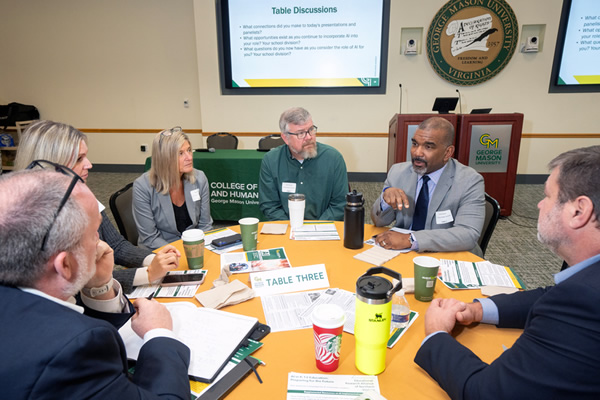 Photo by Evan Cantwell/Creative Services/Office of University Branding/George Mason University
This year’s focus on AI in education within ERA.NOVA reflects the vision of CEHD Dean Ingrid Guerra-López, collaboratively developed with ERA.NOVA’s superintendent partners, positioning the partnership as a catalyst for forward-looking, research-informed solutions for school divisions across the region and advancing the kind of impact that strengthens educational opportunity and readiness for the future.
That shared vision was evident at the ERA.NOVA Fall Convening, which brought together state policymakers, division technology officers, superintendents, and faculty researchers to explore how AI is changing the K-12 landscape across Virginia. Participants shared a common understanding: the question is no longer whether AI belongs in education, but how to implement it in ways that strengthen instruction, prepare students and ensure safety.
Superintendent Dan Hornick of Orange County Public Schools described his district’s efforts to balance innovation with responsibility. “We could not pretend the future does not exist,” he said. “If we do not teach students to use AI responsibly, we are not preparing them for the world they are entering.” His division created flexible guidelines and integrated conversations about AI into curriculum planning and professional learning communities. Success, he said, depends on taking time to address privacy, safety, and teacher preparation before expanding implementation.
At the state level, Calypso Gilstrap, Executive Director of the Virginia Department of Education’s Office of Innovation, outlined the Commonwealth’s Guidelines for AI Integration Throughout Education, which emphasize age-appropriate use, careful tool selection, family engagement, and collaborative policy development. “AI readiness is no longer optional,” Gilstrap said. “There are thirty-two thousand jobs in the United States right now with ‘AI’ in the title. Our students need these skills today, not ten years from now.” By 2029, she added, the department expects AI to be part of problem-based learning across grade levels, beginning with early exposure in kindergarten.
Gilstrap stressed that AI should not be seen as a shortcut to learning. Students must learn to question AI-generated content, verify information, and maintain human connection even as they use digital tools. “Well-trained teachers can use AI to enhance their work, not replace it,” she said.
From George Mason CEHD’s research perspective, Elizabeth Davis, postdoctoral fellow with EdPolicyForward, shared findings from the AI for Responsive Inclusive School Enhancement (ARISE) project, which examines how divisions can use AI to identify and interpret research to expand evidence-based interventions used to support school improvement planning. She coauthored the AI in K-12 Education: What School Divisions May Consider in Preparing for the Future and also authored the companion resource AI in K-12 Education: Preparing for the Future. Both publications were shared with convening participants and highlight emerging research on effective and ethical implementation.
“Efficiency must never come at the cost of human judgment,” Davis said. Her team’s findings, focused on AI literacy, ethical design, and data governance, reflected many of the same priorities discussed by district leaders. Davis also noted that Northern Virginia’s position as the world’s largest data center hub gives the region a unique opportunity to lead in sustainable and ethical AI use.
District technology leaders Aaron Smith of Loudoun County Public Schools and Dr. Sharon Shewbridge of Stafford County Public Schools shared how their divisions are turning policy and research into local action. Smith emphasized the importance of protecting students and ensuring that the tools brought into classrooms are safe and developmentally appropriate. “Our focus has to be on protecting students and understanding what K–12 really needs from AI before we bring it into classrooms,” he said.
Audra Parker, Director of George Mason’s Office of Teacher Preparation, underscored that preparing educators is essential to any successful AI strategy. “AI readiness is ultimately about people,” Parker said. “Teachers need structured opportunities to build confidence, deepen their understanding, and practice using these tools in ways that elevate the irreplaceable human work of teaching. When we invest in educator preparation, we ensure that AI supports learning rather than driving it.”
Throughout the convening, participants agreed that responsible integration of AI requires more than access to new tools. It calls for a shared framework grounded in educator expertise, ethical design, and a commitment to equity. Several divisions are also involving students directly in AI policy discussions, forming advisory committees and encouraging young people to provide feedback on how these technologies are used in classrooms. “Students are already using these tools,” Gilstrap noted. “They are telling us we cannot pretend AI does not exist. The question is how we guide them to use it well.”
The convening also reflected CEHD’s growing role as a thought leader in defining how institutions can prepare students and educators for a future shaped by intelligent systems. Under Dean Guerra-López’s direction, ERA.NOVA is intentionally bridging scholarly expertise with the urgent, practical needs of school divisions navigating AI’s rapid evolution.
Guerra-López emphasized that this kind of collaboration reflects CEHD’s mission to bridge research, policy, and practice for the public good. “Artificial intelligence is accelerating the evolution of work and learning.” Guerra-López said. “We launched this year’s ERA.NOVA focus on AI because our partners told us they needed guidance grounded in both research and real-world practice. As we prepare future educators, we have both an opportunity and a responsibility to lead—to ensure AI strengthens human development, expands opportunity, and supports ethical, future-ready learning across our schools.
The Fall Convening was the first in ERA.NOVA’s 2025–26 series on Artificial Intelligence in Education. Upcoming sessions will continue to explore readiness, capacity building, and ethical implementation across all levels of the education system. Through this work, CEHD and its regional partners are defining what responsible AI leadership looks like in K–12 education, grounded in research, guided by practice, and focused on empowering educators and students to thrive in a changing world.