
Learn more about...

Empowering Students Through Connection: Paul Arena’s Commitment to Special Education
July 6, 2026
By Kiersten Caputy
For Paul Arena, MEd ’15 in Special Education, the path into education was not part of the original plan. But what began as an unexpected career pivot ultimately became a calling centered on connection, advocacy, and helping students believe in themselves.
“I began substitute teaching in 2008 after returning from graduate school in Georgia,” Arena said. “At the time, I was pursuing opportunities in the Sport Management field, but the job market was challenging.” After applying for more than 70 jobs and securing only two interviews, Arena found himself drawn toward working with students, particularly in special education settings. His experience as a counselor with the Fairfax County Park Authority’s Summer Rec-PAC program made the transition feel natural.
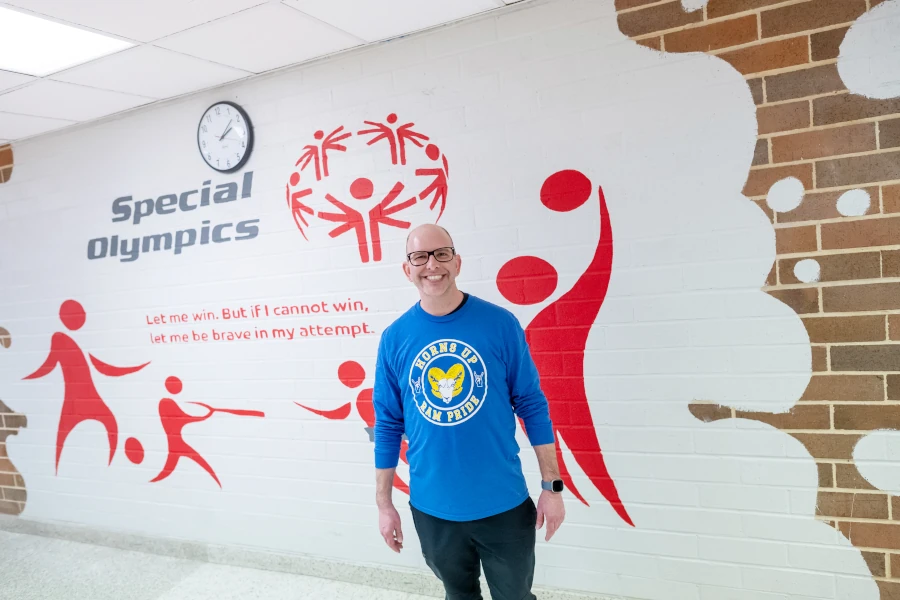
Photo by FCPS Office of Communications
“In 2009, I was hired as an Instructional Assistant, which solidified my interest in education,” Arena said. “I enrolled in George Mason University’s graduate program in Spring 2010, continued as an Instructional Assistant for three years, and was then hired as a provisional teacher. The rest, as they say, is history.”
Today, Arena’s philosophy as an educator extends far beyond academics. He defines success not by grades or test scores, but by helping students develop confidence and self-belief. “I don’t define success by letter grades or wins and losses,” Arena said. “For me, success is helping students believe in themselves and building the confidence they need to grow and take on challenges.”
That approach reflects his belief in supporting the whole child, both academically and emotionally. “When students feel seen, valued, and supported both academically and emotionally, they are far more likely to succeed not just in the classroom, but beyond it,” he said.
Arena also incorporates lessons from his sport management background into his work with students, using athletics and teamwork to reinforce resilience, collaboration, and belonging. “Drawing on my background in sport management, I use teamwork and athletics as powerful tools to reinforce these values,” he said.
Over the years, Arena says his students have shaped him just as much as he has supported them. “My students have taught me the importance of showing up, consistently and with purpose,” Arena said. “Some days they need that support, and other days it’s me who grows from the experience.”
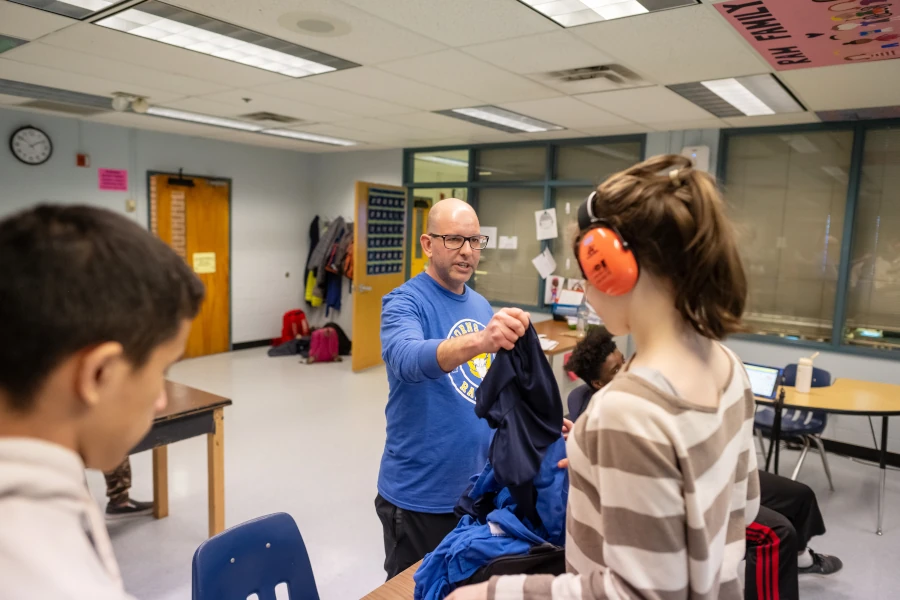
Photo by FCPS Office of Communications
He describes the relationship between educator and student as a “two-way street built on trust, patience, and connection,” principles that continue to guide his work every day. Arena says his time at George Mason’s College of Education and Human Development (CEHD) provided practical preparation that is directly connected to the realities of the classroom. “As an Instructional Assistant, I had the unique opportunity to learn about differentiated instruction in my coursework and immediately apply those strategies in the classroom each day,” Arena said. “That real-time connection deepened my understanding of how to meet diverse learning needs.”
The CEHD experience also reinforced the importance of relationships and classroom culture. “Watching how my professors built relationships, balanced structure with flexibility, and created engaging environments influenced how I approach my own classroom,” Arena said. “Those experiences showed me that strong connections and a positive climate are at the core of effective teaching and leadership.”
Among the many meaningful experiences throughout his career, one annual event stands out above the rest: FanQuest, a Special Olympics basketball game organized through his school’s Partnership class. “Our Partnership class, made up of students with special needs and their general education peers, spends months planning the event,” Arena said. “The gym is filled with nearly 2,000 students, families, and community members, all coming together to support our athletes.”
The event uses the Unified Sports model, where Special Olympians and peer partners compete side by side, creating an atmosphere centered on inclusion and teamwork. “It also tends to get surprisingly competitive,” Arena says. “This year, we even pulled off an overtime victory against neighboring Chantilly High School, coached by fellow CEHD alum Von Corpuz. Moments like that, paired with the joy on our athletes’ faces, are a powerful reminder of why this work matters so deeply.”
For current CEHD students considering careers in special education, Arena encourages them to fully immerse themselves in the experience and invest in relationships. “What I love about special education is the balance of structure and unpredictability,” he said. “Each day has routines, but it can look very different depending on student needs.”
He believes meaningful impact happens when educators extend beyond the classroom walls. “To make a meaningful difference, you must be present and willing to build relationships beyond the classroom,” Arena said. “The more you invest your time and energy, the stronger those relationships become, and that’s where the real impact happens.”
As he looks toward the future, Arena remains motivated by the growth he sees in his students every day. “What continues to motivate me is seeing my students achieve things I once thought might not be possible,” he said. “Those moments of growth, no matter how big or small, are incredibly powerful.”
For Arena, the next chapter is rooted in continuing to build the relationships that make lasting impact possible. “I hope to continue building strong, meaningful connections with students and their families,” Arena said. “Those relationships are the foundation for growth, trust, and long-term success, both in and out of the classroom.”
This story supports the Future Ready Teachers Initiative and our priority of reclaiming the narrative around teaching as a profession.