
Learn more about...

Finding the Magic in the Ordinary: CEHD Alumna Liz Busch Recognized as Preschool Special Educator of the Year
July 20, 2026
By Kiersten Caputy
When Elizabeth “Liz” Busch, MEd ’15, learned she had been named Preschool Special Educator of the Year by the Fairfax County Special Education PTA (SEPTA), she was both surprised and honored. But for Busch, the recognition was meaningful for reasons that went far beyond the award itself. “This was an exciting and unexpected honor,” she said. “With the current political climate and seemingly constant reduction in funding and resources, it is a tough time to be in public education. Sometimes it can be a challenge to remember why we stick with it.”
What made the recognition especially meaningful, she said, was hearing directly from the families she serves. “While I was touched to win the award, the most special and meaningful aspect of it was getting to hear firsthand from parents about how I’ve not only impacted their child’s development but also their family environment as well,” Busch said. “There are so many amazing early childhood special education teachers in FCPS who are so deserving of this recognition, and it’s an honor to be included in their ranks too.”
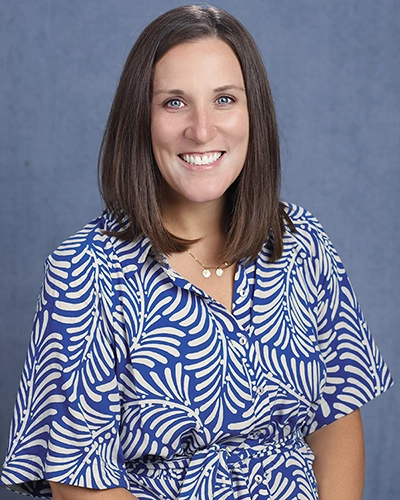
Photo provided
Today, Busch serves as a special education preschool teacher at Cardinal Forest Elementary School, where every day is filled with opportunities to help young learners grow academically, socially, and emotionally.
Her mornings are spent planning instruction, developing Individualized Education Programs (IEPs), collaborating with families and specialists, and supporting preschool-aged students in community settings. The afternoons, however, are her favorite part of the day. “My afternoons are really when joy and magic happen because that’s when my students come into the room,” Busch said.
Her classroom looks much like any preschool classroom: students eat lunch together, participate in circle time, read books, sing songs, play outside, and engage in hands-on learning through art, STEM activities, and imaginative play. Behind every activity, however, is carefully planned instruction designed to meet each child's individual needs. “Embedded in all of these activities is individualized instruction targeting specific areas of need and delays,” she explained. “There are intentionally planned opportunities within our play to practice skills we are learning, whether these skills are self-regulation, peer interaction, attention, communication, or motor skills.”
Busch credits the Inclusive Early Childhood Education program at George Mason University’s College of Education and Human Development (CEHD) with providing the foundation for her professional practice. “My master’s degree at George Mason was really the foundation for all of my practice,” she said. “The courses were practical but challenged me in the best ways. I had to expand my thinking, my perspectives, my creativity, everything.”
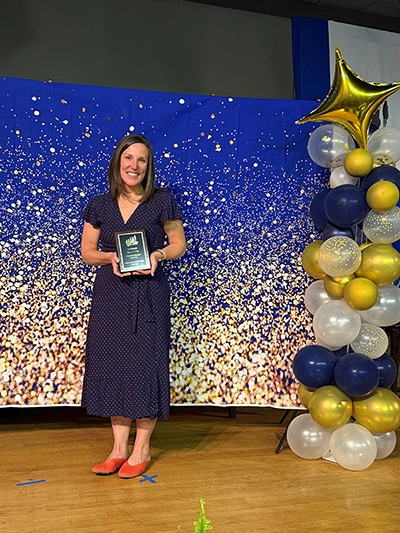
Photo provided
While the coursework was invaluable, the relationships she built at George Mason have remained equally important throughout her career. “Maybe one of the best things about the program is that I met so many other quality educators that I am still in constant touch with,” Busch said. “We went from students together to colleagues in the same role. They are a constant fount of ideas, knowledge, inspiration, collaboration, and sanity.” She added, “Those human connections made at George Mason are so impactful.”
Interestingly, Busch’s original motivation for entering the field was deeply personal. “It might sound silly, but I was originally drawn to early childhood education as a way to understand my own young children and their development,” she said.
At the time, she was part of an active-duty military family and wanted to better understand how to support her own children while navigating potential moves and educational transitions. As she progressed through the program, however, her focus expanded. “I was inspired by the passion of those serving our kids with special needs and doing everything possible to ensure that they had equitable opportunities and access to education and experiences as their peers,” Busch said. “I saw the impact that a quality teacher advocate had not only on students but on their families as well. I realized that I wanted to be able to be that person for others if I could.”
For Busch, success looks different for every student. “Each of my students is so different, so that means success for each of them looks different too,” she said.
She recalls one moment that remains unforgettable. “I will always remember the first time I heard a previously non-verbal student use verbal communication with me to request an item,” Busch said. “I think I was on cloud nine for the rest of the week.”
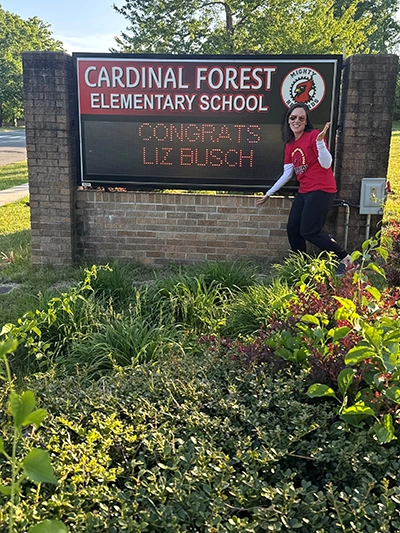
Photo provided
Other moments are quieter but equally as powerful. “We work a lot on self-regulation and peer-interaction skills in my room, and seeing them come to fruition, even if just a brief glimmer, is the best part of the job,” she said. “It is so rewarding to watch a student who previously struggled with meltdowns recognize and use strategies to help themselves calm down.” Then she added, “Honestly, these babies just love you, and they are unashamed to show it. How can it get more rewarding than that?”
Busch believes strong relationships are at the center of everything she does, especially when partnering with families. “Open and consistent communication is key,” she said. “I am someone who values human connection in all areas of my life, and that is the same with my students’ families.”
As both an educator and a parent, she brings empathy and understanding to those relationships. “It is important to me that my parents and families know that they are equal partners in their child’s education and that I truly value their perspective and input,” Busch said. “Ultimately, we are all human and we have the same shared goal for and love of their children…Relationships and trust are the key to so much in education and especially in early childhood education.”
Reflecting on her time at CEHD, Busch points to several mentors who continue to influence her work today. These include Colleen Vesely, academic program coordinator and associate professor in the Inclusive Early Childhood Education program, Julie Kidd (Professor Emerita of Education), and former faculty, Deb Fulcher and Ilham Nasser. “My professors were fundamental in helping us explore what it truly means to work with and partner with families of different cultures,” Busch said. “The coursework helped me personally explore any unconscious biases I may have had, and it was incredibly eye-opening.”
When asked what makes a great early childhood special educator, Busch’s answer reflects the joy she brings to her classroom every day. “Great early childhood special educators need to have the capacity for joy and to see the magic in the ordinary,” she said. “You cannot take yourself too seriously because you’re going to be doing all the voices of characters, all the random dances, and all the silly things just to be able to connect with your students.”
She also emphasizes flexibility, organization, and commitment to lifelong learning. “Even the most experienced teachers always have room to grow, and I think that’s sort of a cool thing about being in this field.”
Looking ahead, Busch is excited about the future of inclusive education in Fairfax County Public Schools. Next year, she will move into a new co-teaching model alongside a general education preschool teacher, creating expanded opportunities for students with and without disabilities to learn together. “Inclusion, when done right, can be a challenge,” she said, “but it’s one I am excited to embark upon.”
For Busch, that challenge is worth embracing because it aligns with the reason she entered the profession in the first place: helping every child feel valued, supported, and capable of success.
And perhaps most importantly, never losing sight of the joy and magic that can be found in the ordinary moments of childhood.
This story supports the Future Ready Teachers Initiative and our priority of reclaiming the narrative around teaching as a profession.